
Commercial landscaping for business properties in Auckland
Commercial landscaping is a different operating model from residential. Here's what good looks like — for forecourts, fronts of office, multi-tenant sites and ongoing care.
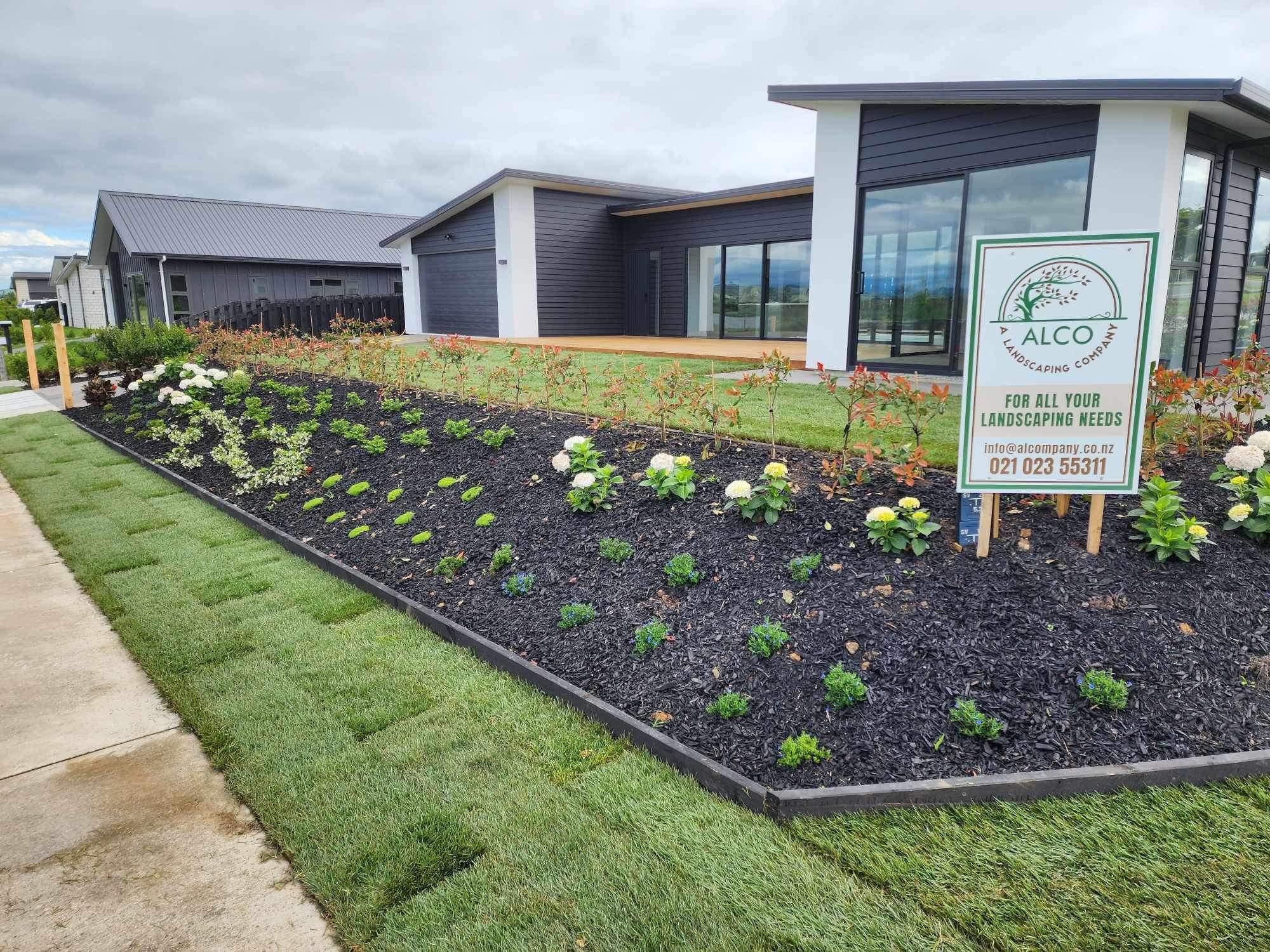
What commercial property managers should expect from a landscape contractor — scope, communication cadence, and maintenance scheduling.
Commercial landscaping often gets treated as a smaller version of residential work. It isn't — the operating model is completely different. The brief is shorter, the budget is line-item, the maintenance schedule has to fit around tenants, and the property manager wants reporting they can put in front of an owner without rewriting it.
We hold ongoing commercial maintenance contracts across Franklin and Auckland — light-industrial sites, office frontages, retail strips, multi-tenant developments — and we do new commercial installs for builders and developers. Here's what we've learned makes commercial landscaping actually work.
1. The brief is operational, not aspirational
Residential briefs are emotional — how you want the space to feel. Commercial briefs are operational — what the property needs to do. Make a strong first impression. Be safe to walk through. Look maintained without anyone having to think about it. Survive contracted use cycles. Stay within an annual maintenance budget.
We start every commercial engagement with that operational brief, not with a design concept. The design follows from it.
2. Specification has to handle the property's worst day
Residential landscapes are designed for the way they'll usually be used. Commercial landscapes are designed for the worst day they'll get. Pavers under a delivery vehicle. A planter beside the smokers' bench. A hedge that screens an air-conditioning unit but has to live in compacted clay.
Material specification on a commercial job is conservative for a reason: lifespan and replacement cost dominate the lifetime equation. We'll often pay more upfront for a finish that will hold for 15 years over one that needs replacing in five.
3. Maintenance is the contract, not an afterthought
On residential work, maintenance is a follow-on conversation. On commercial work it's the main event. The install is one moment; the next 5–10 years of weekly or monthly visits are what determines whether the property keeps looking the way it should.
We structure commercial maintenance around the property manager's reporting cycle — a scheduled visit, a one-page report against an agreed scope, photos of anything that's worth noting, and a heads-up for anything that's going to need attention in the next quarter. No surprises.
4. Communication cadence matters more than communication volume
Property managers deal with a dozen contractors. They don't want phone calls; they want predictability. We agree at the start: who's the single point of contact, what the visit cadence is, how invoices are formatted, what triggers an out-of-cycle call. Then we keep to that. The reason builders and property managers come back to us is that they don't have to manage us.
What commercial scope usually covers
Most commercial briefs we run involve some combination of:
- Forecourts and entry frontages — the first impression at the kerb
- Common-area planting and turf around tenant spaces
- Hardscape: paths, paving, low retaining, accessible thresholds
- Boundary fencing and gates, often with security considerations
- Scheduled maintenance — fortnightly to monthly across the year
- Seasonal resets — mulch, replanting, refresh of focal areas
- Reporting against an agreed maintenance specification
If you're a property manager or builder and the relationship with your current landscape contractor isn't quite where you'd like, we're happy to take a walk-through and put together a comparable scope. The conversation tends to go faster when there's something written to compare against.